
Vented vs Vent-Free Gas Logs — Which Is Right (and Legal) for Your Home?
Both produce flames. Both connect to natural gas or propane. The real differences are how much heat they deliver to the room, how realistic the flames look, and whether they're legal where you live. This guide gives you the answer in 60 seconds.
Authorized Real Fyre dealer · Free specialist help picking the right set for your fireplace and state
Which one is yours?
If you can answer two questions — do you have a working chimney, and do you want the fire to heat the room — you already know your answer.

- You want maximum flame realism — tall, yellow-orange, wood-fire flames
- You have a working chimney with a damper
- Your jurisdiction restricts vent-free — Minnesota, Wisconsin and NYC ban it, and California bars the sale of vent-free heaters
- You don't need primary heat from the logs — this fire is for ambiance

- You need supplemental room heat — up to 30,000 BTU stays in the room
- Your fireplace doesn't have a working chimney
- Your local building department confirms vent-free is allowed at your address
- You accept smaller, cleaner flames in exchange for real warmth
Every difference that matters
| Vented | Vent-Free | |
|---|---|---|
| Flame realism | Excellent — full wood-fire look | Good, but smaller, cleaner flames |
| Heat to room | Low (~10% of BTU stays in the room) | High (~99% of BTU stays in the room) |
| BTU output | 60,000–90,000 BTU | 20,000–40,000 BTU |
| Damper position | OPEN during operation (mandatory) | CLOSED during operation |
| Working chimney needed? | Yes | No |
| Code-restricted states | None | Minnesota, Wisconsin and NYC prohibit; California bars the sale (§19881); Massachusetts allows with a permit |
| Oxygen depletion sensor | Not required | Mandatory (built into every set) |
| Indoor air quality | Combustion byproducts go up the chimney | Combustion byproducts vent to the room |
| Operating cost (natural gas) | $0.70–$1.10 per hour | $0.30–$0.50 per hour |
Why vented wins on looks
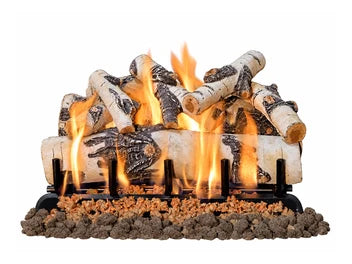
Vented gas logs are designed to burn like wood — that's how they generate tall, yellow-orange flames with natural, random movement. The combustion byproducts are drawn up the open chimney along with most of the heat. The trade-off: you lose roughly 90% of the BTU output up the flue, so the room doesn't warm significantly.
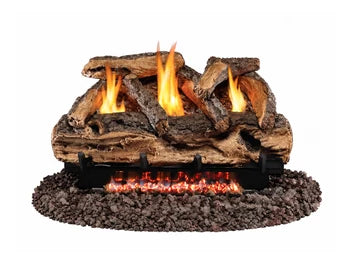
Vent-free gas logs are engineered for complete combustion — minimal soot, smaller and cleaner flames, closer to a gas range than a wood fire. The trade-off flips: you keep 99% of the BTU in the room, so a vent-free set is genuine supplemental heat.
Real sets, both types
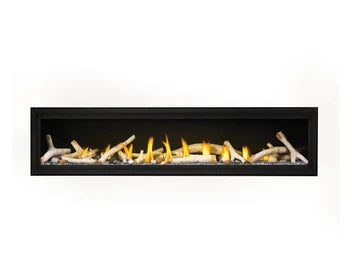
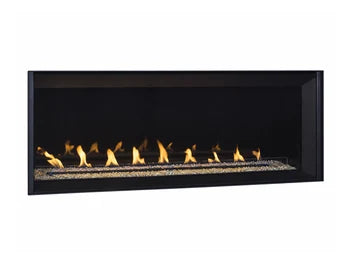
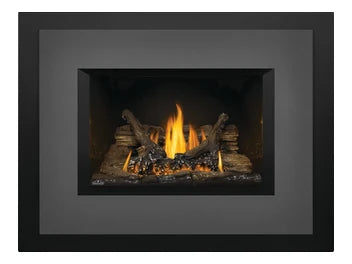
Every photo below is a set we carry — compare the flame character yourself.


Where vent-free gas logs are restricted
There is no national list, and anyone who shows you a tidy map of "legal in 44 states" is guessing. Vent-free rules are written into state codes, city codes and county amendments, and the adopted edition changes from one town to the next. Below is only what the actual code text says. Everywhere else, the person with the answer is your local building or fire official — not a website.
| Jurisdiction | What the rule actually says |
|---|---|
| Minnesota | Prohibited. Minnesota Rules 1346.5621 bars unvented gas-fired heaters — and Minnesota is the one state whose rule reaches decorative vent-free log sets by name, not just heaters. |
| Wisconsin | Prohibited. Wisconsin Administrative Code SPS 365.0621 bars unvented gas-fired heating appliances in dwellings. |
| California | Sale prohibited — with a written exception. California Health & Safety Code §19881 bars the sale of unvented gas heaters in the state. The statute carves out decorative vent-free log sets installed in a vented fireplace, which is why some vent-free sets are still sold here and most are not. We are in Laguna Hills, so ask us — we deal with this one weekly. |
| New York City | Prohibited. NYC does not allow unvented gas log sets. The rest of New York State is decided county by county — check locally before you order. |
| Massachusetts | Allowed, with conditions — despite what most competitor pages claim. Massachusetts permits vent-free gas log sets subject to conditions that include a permit from the local fire department, a carbon monoxide detector, and a 40,000 BTU/hr limit. |
| Manufactured & mobile homes (all states) | Prohibited federally. HUD's manufactured home construction standard, 24 CFR 3280.707, does not permit unvented fuel-burning heaters in a manufactured home — regardless of which state it sits in. |
| Everywhere else | Usually allowed, locally conditioned. Common local add-ons: a BTU cap tied to room volume, no installation in bedrooms or bathrooms, and a required oxygen depletion sensor (every set we sell has one). |
The rule is your jurisdiction, not your state. Two towns 20 minutes apart can answer differently, because they adopted different code editions. One phone call to your building department settles it before you spend a dollar. Not sure? Call us at (949) 619-7824 — we will tell you honestly if vented is the safer purchase for your address, and a vented set gives you the better flame anyway. Browse vent-free sets, size yours with the gas log sizing tool, or see what a gas log set costs to run.
Why some homeowners are skeptical of vent-free
Vent-free gas logs release combustion byproducts — water vapor, CO2 and trace CO — directly into the room. The technology has been refined over 40+ years, and every modern set includes multiple layers of protection:
When installed in compliance with manufacturer specs, vent-free is rated as safe by ANSI Z21.11.2, the governing standard. The lingering skepticism mostly traces back to older, pre-1990s designs that lacked ODS technology.
Gas log series at ExceptionalFire
We're an authorized Real Fyre dealer and carry vented and vent-free options across the catalog — including the full Hargrove lineup. Vented Real Fyre and Grand Canyon log sets carry a lifetime warranty.


Also in the catalog: Grand Canyon Gas Logs and Formation Creation — see the full Gas Logs Buyer's Guide for the brand-by-brand breakdown.
Both types size by firebox width
| Log set size | Firebox front width |
|---|---|
| 18″ logs | Fireboxes 24–30″ wide |
| 24″ logs | Fireboxes 30–36″ wide |
| 30″ logs | Fireboxes 36–48″ wide |
Measuring takes three minutes with a tape measure — see How to Measure a Fireplace for Gas Logs, or let the Gas Logs Sizing Tool do the math from four numbers.
One rule: never DIY the gas line
Both vented and vent-free sets require a licensed plumber or gas fitter for the gas line connection. Once the gas line is in place, log set installation is 30–60 minutes for a qualified installer.
Frequently asked questions
Are vent-free gas logs legal in my state?
Are vent-free gas logs legal in Massachusetts?
Can I convert from vented to vent-free or vice versa?
Do vented gas logs really produce no heat?
Will vent-free gas logs make my room smell?
Can I install glass doors with vented gas logs?
Can I install glass doors with vent-free gas logs?
What's the typical lead time?
Order the right set the first time
Browse the full catalog, or answer three quick questions and let the sizing tool match a set to your firebox, your state and your gas type. A specialist double-checks every order.
Prefer a human? Call (949) 619-7824 — we'll pick the right set for your fireplace and state together.